ABOUT ME
I am Tali Belle — a devotee of the beautiful, the multi-dimensional, the infinite and the profound. Over the last eight years I have devoted myself to the slow, humbling work of returning to my body and what it means to be fully inhabit my humanity in relationship to others and the other-than-human world. This exploration and continual inquiry has led me down a number of different pathways — from earth-tending stewardship to music, to dance, to poetry, and to many different corners all over the world where I have had the opportunity to immerse myself as a student within diverse cultures and communities. It has been a process of researching, learning, embodying, and experiencing; a process that is still, and forever, ongoing. My work today has continued to expand from this original source of inquiry.
I hold a background in Neuro-Linguistic Programming and coaching, trauma-informed somatic therapies, psychic somatics, and the shamanic arts. I am currently entering a three-year Master’s pathway in Psychotherapy, deepening the clinical and psychological foundations that support the intensity of the work I facilitate. My medicine acts as an interface between the nervous system and the mythic field, the primordial and the celestial, physiology and archetype, trauma science and the subtle dimensions of human experience. The depth of what I offer has not been formed through modality collection alone, but through lived initiation. I have walked through my own unraveling. I have studied the architecture of my own trauma, my own fragmentation, my own illusions of power and powerlessness. And so every space that I hold, whether that be for clients in the field of my work or within casual conversation with a dear brother or sister, is a direct extension of my own lived experiencing.
At the centre of both my life and my work (which are very synonymous with one another) is sovereignty — as a lived and continually tested capacity to remain in relationship with my own interiority whilst participating fully in the world. I have come to understand sovereignty as the ability to hold authorship over one’s responses, to take responsibility for the shaping forces of the psyche and nervous system, and to engage life from a place of conscious participation rather than unconscious reenactment. It is collaborative, reciprocal, and always relational, yet never co-dependant. Sovereignty is the central axis for how I show up and inhabit my humanity. For much of my early life, I moved in ways that dispersed my power outward. I deferred to authority figures, to relational dynamics, to inherited narratives about who I was and how I was meant to function. I sought safety in coping mechanisms that softened discomfort but reinforced fragmentation. There was a pervasive lack of ownership over my inner world, and without that ownership, my experience of life was largely reactive. In the absence of sovereignty, victimhood became an organising principle. Victimhood strips us of our sovereignty.
The restoration of sovereignty, then, is not about denying pain or bypassing history; but about gradually and courageously placing authorship back into our own hands. It requires examining the subtle ways we participate in our own diminishment, the narratives we continue to rehearse, and the unconscious allegiances we hold to versions of ourselves that were formed in survival. It involves peeling back layers of conditioning, projection, and protective patterning so that something more fundamental can be accessed. A core truth that exists beneath noise and adaptation. The soul.
The spaces I hold are structured as modern-day initiatory chambers or rites of passage. Not dramatic or performative, but intentional acts that we allow to reveal themselves moment to moment. They are fields in which the nervous system can stabilise enough for truth to be uprooted, and in which the mythic dimension of existence can be engaged without bypassing the psychological and physiological work required to sustain it. I stand as both guardian and gatekeeper, holding the threshold for those who are ready to step beyond illusion and into truth. And I will walk beside you as an equal committed in collaboration.
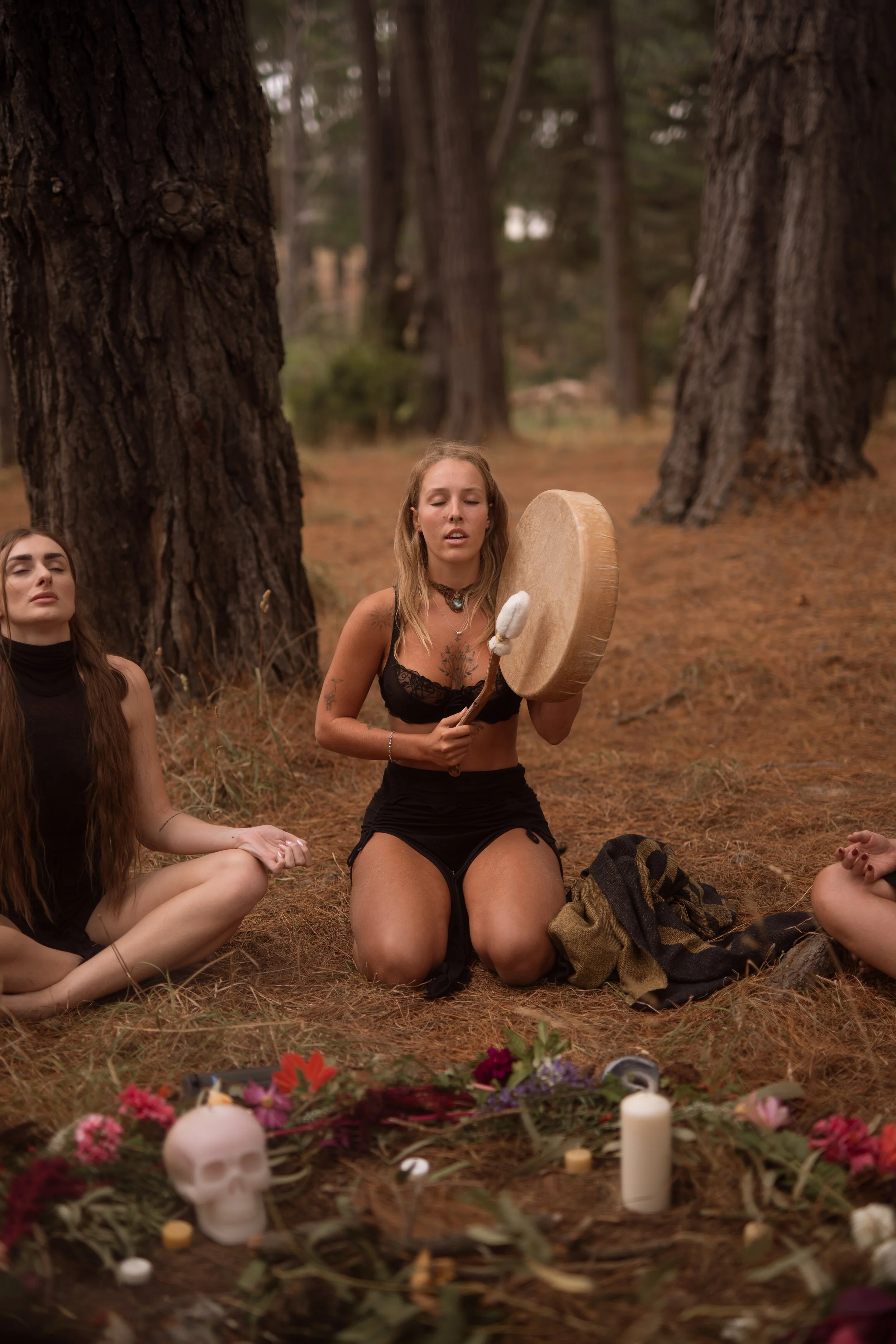
I believe what we are missing within our modern world is the marrying of both the scientific and the shamanic. The acknowledgment of two models that allow us to relate to the world — one not being more valid than the other; but each illuminating a different layer of multi-dimensional, multi-disciplinary reality. We often fear contradiction when it comes to diagnosis because we assume it will undermine our credibility. But what if contradiction is not collapse — what if it is dimensionality? What if pathology and initiation can/does coexist? What if trauma response and energetic interference are not mutually exclusive, but interacting variables within a more complex ecology of consciousness? We have been conditioned to believe that legitimacy requires singularity. That if one framework is correct, the other must be illusion. Yet consciousness has never been that binary.
The question, therefore, that I am more interested in asking is can we hold multiple explanatory frameworks at once without collapsing into confusion or dogma?
The scientific model offers mechanism. It explains how the nervous system responds to prolonged stress, how neural pathways strengthen around threat, how perception becomes biased toward danger. It gives us language for regulation, treatment, and repair. It provides containment. The shamanic model offers relational context. It asks not only what is happening within the brain, but how the individual is interfacing with forces beyond what is visible or tangle. The shamanic/spiritual model acknowledges the unseen forces that are at play and addresses an issue, disease, fracturing from a different plane of experiencing. It addresses sovereignty, permeability, resonance, and the ethics of attention. It treats fear not only as chemistry, but as currency. Chronic fear states dysregulate the autonomic nervous system. This is measurable. They also alter perception, increase suggestibility, and heighten sensitivity to environmental cues. From a shamanic perspective, this same dysregulation can be understood as thinning the boundary between psyche and field — increasing permeability.
When we exile one in favour of the other, we fragment our understanding. Not only that, but our approach becomes somewhat dangerous. When we are blind or biased towards one model — we become enslaved to our own internal projections as opposed to the truth of what an individual may be needing in a moment. We may misdiagnose spiritual crisis as psychosis or misdiagnose trauma response as spiritual interference. The ability to hold multiple truths at once, despite what our conditioning or programming has told us, requires a deep level of humility, curiosity, and openness to the nature of existence. If we rely solely on science, we risk reducing profound existential and transpersonal experiences to malfunction. If we rely solely on mysticism, we risk bypassing the physiological realities of trauma and dysregulation. In both cases, something essential is missed.
The invitation? Integration.